
Why Burnaby roofs fail at valleys: causes and fixes
Why Burnaby roofs fail at valleys: causes and fixes
TL;DR:
- Roof valleys are the most failure-prone area on Burnaby homes because they concentrate water from multiple roof slopes. This, combined with persistent rainfall, moss growth, and debris accumulation, accelerates wear on underlying roofing layers. Regular maintenance and professional inspections can prevent hidden damage and prolong valley lifespan.
Roof valleys are the single most failure-prone area on any Burnaby home, because they concentrate water from two or more roof slopes into one narrow channel. That concentrated flow, combined with Burnaby’s year-round rainfall, heavy tree cover, and persistent moss growth, accelerates wear on the hidden underlayment and flashing layers beneath your shingles. Most homeowners only notice a problem when a stain appears on the ceiling, but by then the damage has usually been building for months. Understanding why Burnaby roofs fail at valleys gives you a real chance to stop that damage before it spreads.
Why are roof valleys the weakest point on a Burnaby roof?
A roof valley is the V-shaped channel formed where two roof slopes meet. Think of it like a storm drain for your entire roof. Every raindrop that lands on either slope eventually runs toward that channel, so the valley handles a far greater volume of water than any flat section of shingles.
That concentrated flow creates several problems that do not exist on open roof fields:
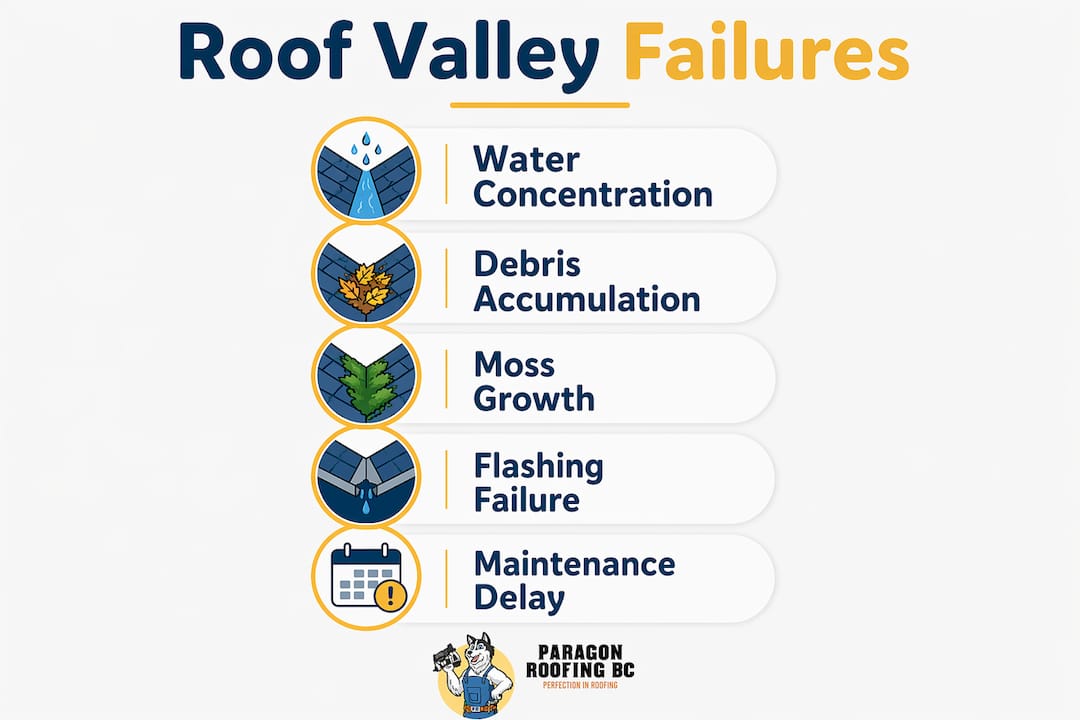
- Higher water volume: Valleys carry water from two slopes simultaneously, meaning the shingles, flashing, and underlayment in that channel wear down faster than anywhere else on the roof.
- Debris funnelling: Leaves, pine needles, and moss spores all migrate toward valley low points due to roof geometry. They compact over time, slow drainage, and hold moisture against your roofing materials for days after a storm.
- Thermal movement stress: Metal flashing expands in summer heat and contracts in winter cold. Thermal expansion and contraction cycles cause flashing seams to split and corrode, making valley flashing the weakest metal component under coastal environmental stress.
- Accelerated material wear: Because water sits longer in valleys than on open slopes, shingles in valleys granulate faster, underlayment softens sooner, and sealants crack years ahead of schedule.
Understanding proper valley construction helps explain why even a well-built roof can develop valley problems when maintenance is neglected. The geometry is simply unforgiving.
How does Burnaby’s climate speed up valley failure?
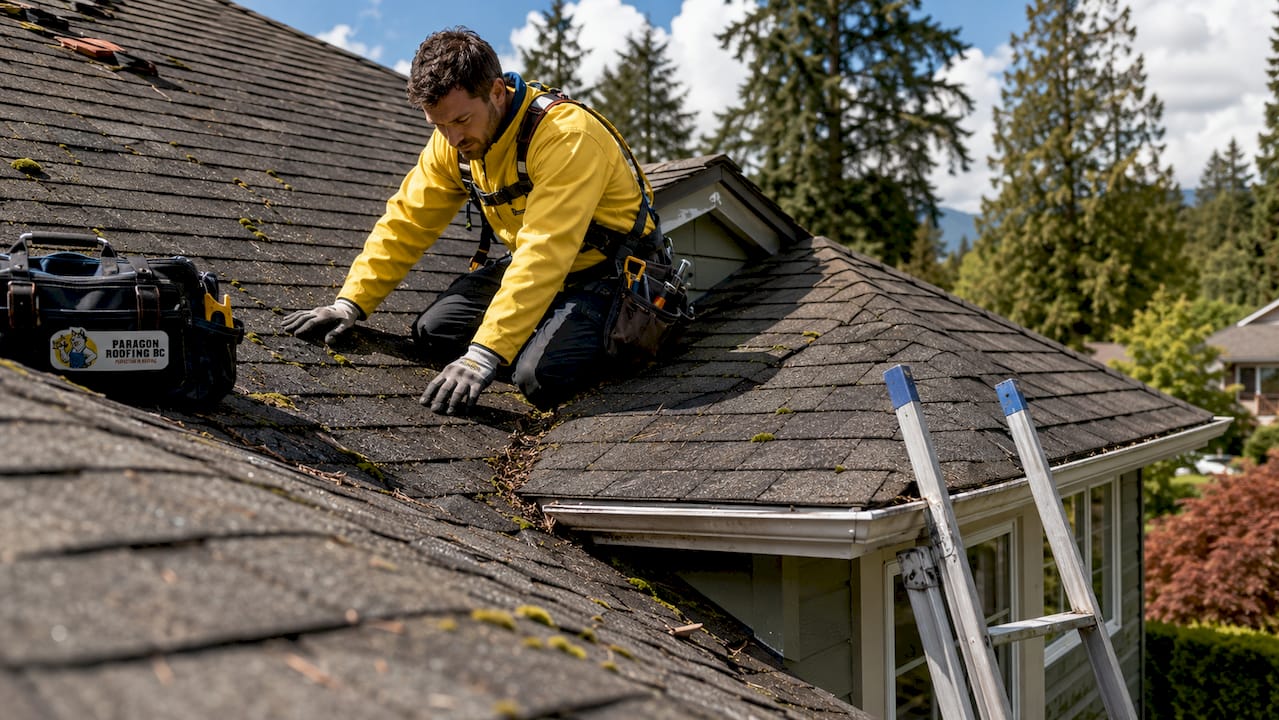
Burnaby sits in the Pacific Northwest, and that means wet. The city receives consistent rainfall from october through april, with overcast and damp conditions persisting well into spring. Valleys rarely get a chance to fully dry out between storms, which is a serious problem for roofing materials that depend on dry cycles to stay intact.
Valley maintenance intervals in Pacific Northwest climates run roughly every two years, compared to approximately five years in arid climates. That difference reflects how much faster organic debris and moss accumulate when conditions stay wet. Burnaby homeowners who treat their roof like a set-and-forget system are essentially letting a two-year maintenance clock run unchecked.
Tree cover makes things worse. Burnaby neighbourhoods like Metrotown, Burnaby Mountain, and South Slope are lined with mature conifers and deciduous trees. Those trees drop needles, seeds, and leaves directly onto your roof, and gravity pulls all of it straight into the valleys. Once that debris compacts, it acts like a sponge, holding moisture against your shingles and flashing long after the rain stops.
Moss thrives in shaded, moist valleys and physically lifts shingle edges as it grows. Once shingle edges lift, water finds a path beneath them and reaches the underlayment. From there, the damage is hidden and silent.
Pro Tip: Trim overhanging branches back at least two metres from your roofline. Reducing debris fall into valleys is one of the most cost-effective ways to extend valley life in Burnaby.
What hidden failures actually cause valley leaks?
Most homeowners assume a leaking valley means damaged shingles. That assumption leads to patch repairs that do not fix the real problem. The shingles are often the last layer to show visible wear. The failures that actually let water in are usually buried underneath.
“Valleys can appear fine on visual inspection while underlying layers are compromised, necessitating professional inspection for accurate diagnosis.” — Paragonroofingbc field experience, consistent with industry findings on hidden valley failures.
Here is what is actually failing beneath the surface:
- Underlayment breakdown: The underlayment, often an ice-and-water shield membrane in valleys, is your last line of defence before water reaches the roof deck. Underlayment failures from poor installation or aging allow water to penetrate the deck and travel along rafters before appearing as a ceiling stain.
- Flashing seam separation: Proper valley flashing uses overlapping metal layers to redirect concentrated rainwater away from seams. When those seams corrode or separate, water bypasses the metal entirely and soaks into the roof structure.
- Water travelling internally: Leaks appear below the actual point of water ingress by several feet. A stain on your living room ceiling may trace back to a flashing failure two metres up the valley. That gap between cause and symptom is why patch repairs so often fail.
- Misdiagnosis as a shingle problem: Replacing or patching shingles over a failed underlayment or corroded flashing is like putting a fresh coat of paint over rot. The underlying failure continues, and the leak returns within one or two rain seasons.
The same hidden-failure pattern applies when you look at why Burnaby roofs fail around chimneys. Chimneys and valleys share the same vulnerability: flashing and underlayment do the real waterproofing work, and both are invisible until something goes wrong.
Blocked gutters compound valley problems by causing water to back up and increase pressure on already-stressed valley materials. Keeping gutters clear is not just about drainage. It directly protects your valleys.
How can you prevent valley failures before they start?
Prevention costs a fraction of what repairs cost once water has reached the roof deck. The following steps are practical for any Burnaby homeowner or property manager.
-
Clear debris every two years at minimum. Given Burnaby’s climate, valley maintenance every two years is the standard interval. Remove leaves, pine needles, and compacted organic matter from valleys before they hold moisture against your flashing.
-
Treat moss before it lifts shingles. Apply a zinc or copper-based moss treatment to valley areas in early spring, before the growing season. Once moss physically lifts shingle edges, the damage to the underlayment below has already begun.
-
Inspect flashing edges after major storms. Walk the perimeter of your home after a heavy rain event and look for water staining on fascia boards near valley termination points. Staining at the eave below a valley is an early warning sign of flashing separation.
-
Do not rely on patch repairs alone. Repeated valley repairs on older roofs indicate wider roofing deterioration beyond visible symptoms. If you have patched the same valley twice in three years, the underlayment or flashing needs full replacement, not another patch.
-
Book a professional inspection every three to five years. A qualified roofer can lift valley shingles and check underlayment condition, flashing seam integrity, and deck moisture. Visual inspection from the ground tells you almost nothing about what is happening beneath the surface.
Pro Tip: Ask your roofer to check the common roofing problems around all roof junctions during a valley inspection. Valleys, chimneys, and skylights share similar failure modes and are best assessed together.
Key takeaways
Burnaby roof valleys fail because they concentrate water, debris, and moss while hiding the real damage beneath shingles in the underlayment and flashing layers.
| Point | Details |
|---|---|
| Valleys carry the most water | Two slopes drain into one channel, accelerating wear on shingles, flashing, and underlayment. |
| Burnaby climate shortens maintenance cycles | Pacific Northwest conditions require valley maintenance roughly every two years, not five. |
| Hidden layers fail first | Underlayment and flashing failures cause most leaks, not visible shingle damage. |
| Patch repairs mask deeper problems | Repeated patching without addressing underlayment or flashing leads to ongoing leaks. |
| Professional inspection is necessary | Visual checks from the ground cannot detect hidden underlayment or flashing failures. |
What I have learned from inspecting Burnaby valleys
Hey, it’s Harman here. After inspecting roofs across Burnaby for years, the pattern I see most often is this: a homeowner calls about a ceiling stain, we get up on the roof, and the shingles look fine. No cracked tabs, no obvious missing pieces. Then we lift the valley shingles and find an underlayment that has been saturated and soft for probably two winters.
The frustrating part is that most of those situations were preventable. The homeowner had the roof “checked” at some point, but whoever looked at it only walked the perimeter and eyeballed the shingles. That is not a valley inspection. A real valley inspection means getting hands on the flashing seams, pressing on the underlayment, and looking for any sign of corrosion at the metal overlaps.
The other thing I want homeowners to understand is that valleys and chimneys are connected problems. When I find a failed valley, I almost always find compromised chimney flashing nearby. Both areas rely on the same flashing and underlayment system, and both get hit by the same concentrated water and debris. Fixing one without checking the other is a half-measure.
My honest advice: do not wait for a ceiling stain to think about your valleys. By the time water shows up inside, the roof deck has likely been wet for a while. A proactive inspection every few years costs far less than replacing a section of decking and the insulation below it.
— Harman
Paragonroofingbc valley inspections and repairs for Burnaby homes
Valley failures are one of the most common roof problems Paragonroofingbc sees on Burnaby properties, and they are also one of the most preventable with the right maintenance approach.

Paragonroofingbc offers roof leak detection and repair services specifically designed to find hidden valley and flashing failures before they reach your ceiling. The team inspects underlayment condition, flashing seam integrity, and moss penetration during every valley assessment. For homes with active moss growth, professional moss removal and treatment protects valley materials between full inspections. For homeowners ready to address valley damage at the source, Paragonroofingbc provides residential roofing services across Burnaby, including full valley rebuilds with proper ice-and-water shield installation.
FAQ
Why do roof valleys fail before other roof areas?
Valleys concentrate water from two slopes into one channel, creating higher wear on shingles, flashing, and underlayment than anywhere else on the roof. Debris and moss also accumulate in valleys due to roof geometry, prolonging moisture exposure.
How often should Burnaby homeowners maintain their roof valleys?
Valley maintenance in Pacific Northwest climates like Burnaby is recommended roughly every two years. Arid climates can extend that interval to approximately five years, but Burnaby’s rainfall and moss growth make the shorter cycle necessary.
Can I tell if my valley is failing just by looking at it?
Not reliably. Valleys can look fine from the ground or even on a surface inspection while the underlayment and flashing beneath are already compromised. A professional inspection that involves lifting valley shingles is the only accurate way to assess hidden layer condition.
What is the difference between a valley flashing failure and a shingle failure?
Shingle failures are visible surface damage like cracked tabs or missing pieces. Flashing failures occur at the metal seams beneath the shingles and allow water to bypass the surface layer entirely. Most valley leaks trace back to flashing or underlayment, not shingles.
Does moss on my roof valley actually cause leaks?
Yes. Moss physically lifts shingle edges as it grows, creating gaps that allow water to reach the underlayment below. It also retains moisture against roofing materials long after rain stops, accelerating deterioration of both shingles and flashing.
Recommended
Our Roofing Blog


Have more questions about roofing?
Check out our FAQs or give us a call today to speak to an expert roofer in Vancouver Lower Mainland, BC. We're here to help our neighbours make educated decisions about their roof. For our team, we value helping clients save money while making their roofs last.