What is low-slope roofing? A practical BC guide
What is low-slope roofing? A practical BC guide
TL;DR:
- Low-slope roofs have a slight pitch between ¼ and 3:12 that depend on waterproof membranes instead of gravity for drainage. Proper design, high-quality installation, and routine maintenance are essential to prevent ponding, leaks, and membrane failure in Vancouver’s demanding climate. Choosing appropriate materials like TPO, EPDM, or modified bitumen, combined with effective drainage and expert inspections, extends roof lifespan and avoids costly damage.
If you’ve ever been told your building has a “flat roof,” there’s a good chance that description isn’t quite accurate. What is low-slope roofing, exactly? It’s a roof designed with a very slight pitch, typically between ¼:12 and 3:12, that relies on waterproof membranes rather than gravity alone to manage water. In Metro Vancouver, where rainfall is relentless and freeze-thaw cycles can punish a poorly designed roof all winter long, understanding how these systems actually work is the difference between a roof that lasts 25 years and one that fails in five.
Table of Contents
- Key takeaways
- Low-slope roofing: definition and key characteristics
- Low-slope roofing materials for Metro Vancouver’s climate
- Common risks and challenges with low-slope roofs in BC
- Inspection, maintenance, and best practices for longevity
- Cost considerations and choosing the right system
- My honest take on low-slope roofing in BC
- Get expert low-slope roofing help from Paragonroofingbc
- FAQ
Key takeaways
| Point | Details |
|---|---|
| Low-slope is not flat | Proper drainage requires a minimum slope of ¼ inch per foot to prevent ponding. |
| Membranes do the heavy lifting | Continuous waterproof membranes replace gravity-based shedding on low-slope systems. |
| Material choice matters less than install quality | Seam sealing and flashing workmanship determine longevity more than membrane brand. |
| Maintenance prevents costly failures | Routine inspections can extend roof lifespan by up to 30%. |
| BC’s climate demands specificity | Coastal moisture, heavy rain, and freeze-thaw cycles require engineered drainage and robust membranes. |
Low-slope roofing: definition and key characteristics
The low-slope roofing definition, as understood by professionals, refers to any roof with a pitch between ¼:12 and 3:12. That means for every 12 inches of horizontal run, the roof rises somewhere between a quarter inch and three inches. It looks nearly flat to the eye, but that slight pitch is doing critical work.
The key distinction between low-slope and steep-slope systems comes down to how they handle water. Steep roofs shed water by gravity, much like water running off a tilted tray. Low-slope roofs can’t rely on that same speed of runoff, so they use a fundamentally different approach: waterproof continuous membranes that seal the entire surface, rather than overlapping shingles that simply direct water downward.
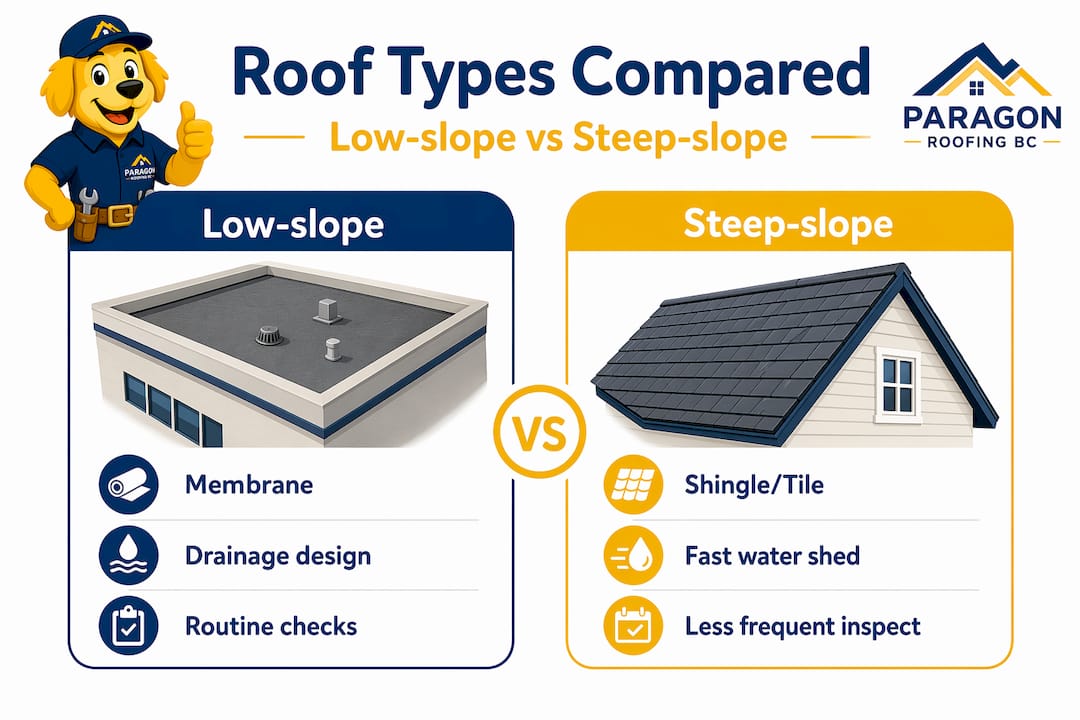
Here’s where property owners often run into trouble. They assume that because shingles worked fine on their house, they’ll work on a low-slope addition or commercial roof. That assumption is expensive. Installing shingles below a 2:12 pitch voids warranties and typically violates building code, because shingles simply cannot resist the hydrostatic pressure of water pooling against them.
A properly designed low-slope roof includes several engineered elements:
- Positive drainage with a minimum slope of ¼ inch per foot across the entire deck
- Tapered insulation to create consistent slope even when the structural deck is level
- Drain sumps positioned at low points to encourage water movement toward outlets
- Flashing details that seal all penetrations, edges, and transitions watertight
Pro Tip: If you’re reviewing a design or quote for a new low-slope roof, ask specifically how positive drainage is achieved. Tapered insulation adds upfront cost, but it’s far cheaper than dealing with ponding damage three years down the road.
Low-slope roofing materials for Metro Vancouver’s climate
Metro Vancouver’s heavy rainfall, freeze-thaw cycles, and coastal moisture create a demanding environment. Not every membrane performs equally here. Choosing the right system is about matching material properties to what our local weather actually throws at a roof.
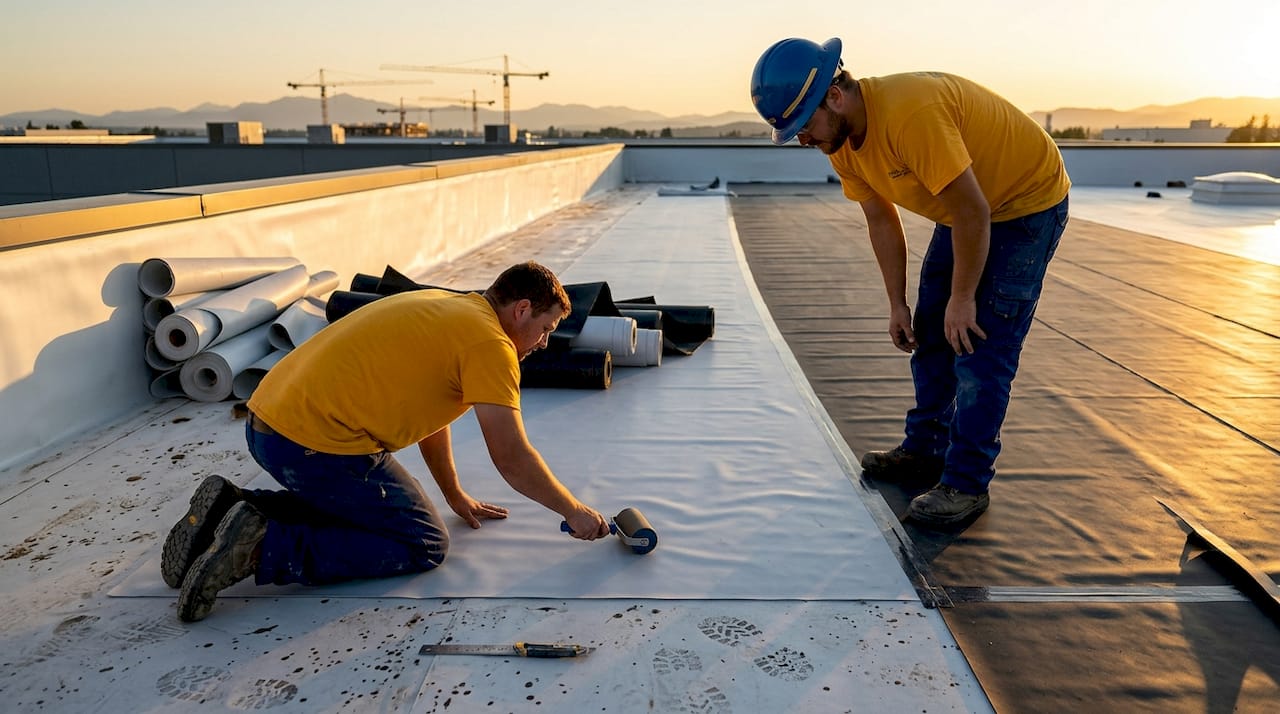
The three most common low-slope roofing materials you’ll encounter in BC commercial and industrial projects are TPO, EPDM, and modified bitumen. Each has a distinct profile:
| Material | Durability | Heat reflection | Puncture resistance | Best application |
|---|---|---|---|---|
| TPO | 15–25 years | High (white surface) | Moderate | Commercial, energy-efficient builds |
| EPDM | 20–30 years | Low (dark surface) | Good | Industrial, budget-conscious projects |
| Modified bitumen | 15–20 years | Moderate | High | Multi-layer, high-traffic rooftops |
EPDM, TPO, and modified bitumen each bring specific advantages depending on your project’s exposure, access requirements, and budget. In coastal BC, where UV exposure is less intense than the prairies but moisture is relentless, EPDM’s exceptional resistance to weathering makes it a reliable performer. TPO, with its heat-welded seams, provides a cleaner waterproof barrier and reflects solar heat during those rare but intense summer stretches.
Modified bitumen is a favourite on rooftops where trades access is frequent, like mechanical rooms and rooftop HVAC areas, because it tolerates foot traffic well. It’s also applied in multiple layers, which adds redundancy.
Drainage design is equally part of the system. Internal drains work well for large commercial rooftops but require routine drain cleaning at least twice annually to stay functional in BC’s leaf-fall and debris-heavy seasons. Scuppers and gutters suit smaller buildings but need regular clearing. For drainage solutions specific to Vancouver’s commercial rooftops, the configuration matters as much as the membrane above it.
Pro Tip: When spec-ing a new low-slope system, ask your contractor whether they’re using PVC membrane installation as an option. PVC offers excellent chemical resistance and weldable seams that hold up well in BC’s wet conditions, particularly around mechanical penetrations.
Common risks and challenges with low-slope roofs in BC
Low-slope roofs in the Lower Mainland face a specific set of challenges that you won’t find on the same scale elsewhere in Canada. Here’s what tends to go wrong, and why.
-
Ponding water. Water remaining on a roof surface for more than 48 hours is classified as ponding, and it’s the most common low-slope failure trigger. Ponding adds weight, accelerates membrane breakdown, and can cause structural deflection that makes the problem progressively worse.
-
Blocked drainage. Clogged drains, inadequate slope, and deck deflection are the leading causes of drainage failure. In Metro Vancouver, autumn leaf debris and moss accumulation can block drains in a matter of weeks.
-
Freeze-thaw damage. Water that ponds and then freezes expands. That expansion works against seams, flashings, and any minor crack in the membrane. One or two wet winters can turn a hairline seam separation into a significant interior leak.
-
Membrane shrinkage and UV degradation. EPDM in particular can shrink over time, pulling flashings away from walls and curbs. Regular inspection catches this before it becomes a water entry point.
-
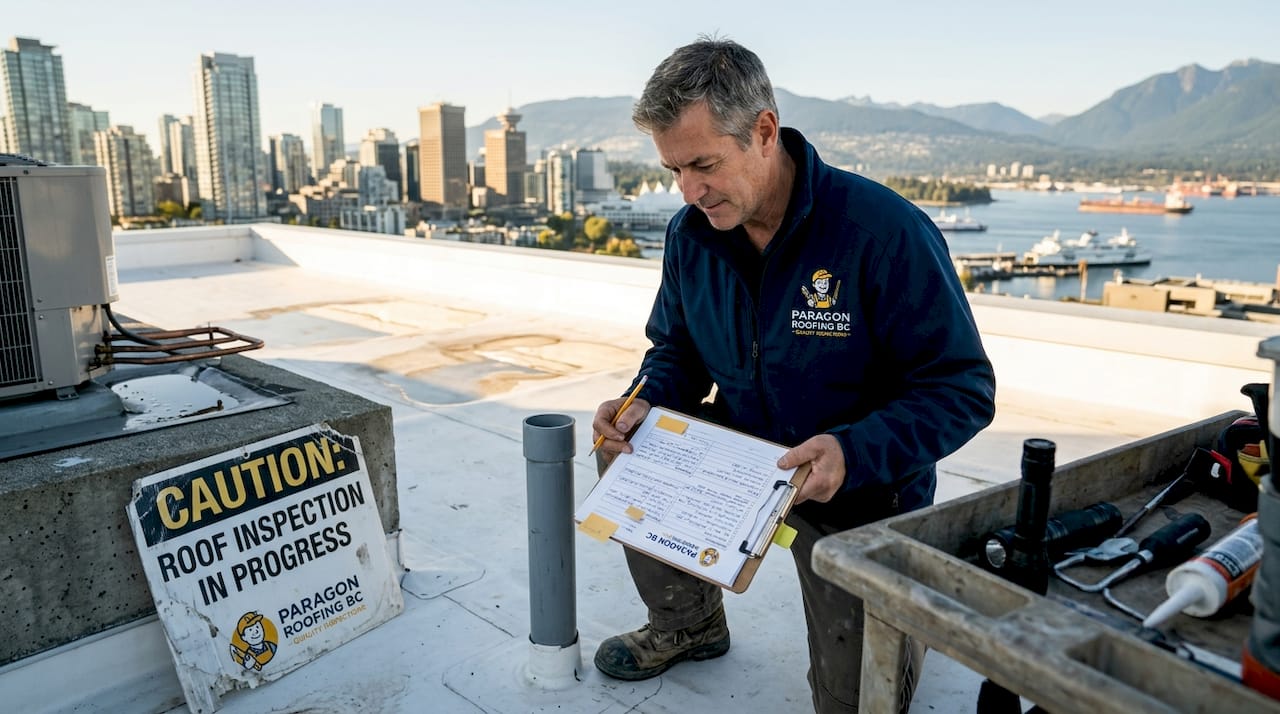
Improper installation of flashings. Penetrations for HVAC equipment, vents, and skylights are the most common leak points on any low-slope roof. Poor sealing at these transitions causes the majority of low-slope roof failures I see on inspections.
“A low-slope roof doesn’t announce its problems loudly. Water finds the path of least resistance, and by the time you see a stain on your ceiling, the damage inside has often been building for months.”
The structural consequences of ignoring ponding deserve special mention. Deck deflection creates a bowl effect that draws more water to the lowest point, where the membrane is under the most stress. It becomes a self-reinforcing problem.
Inspection, maintenance, and best practices for longevity
Maintaining a low-slope roof in Metro Vancouver isn’t complicated, but it does require consistency. A roof that gets regular attention lasts significantly longer than one that’s checked only when something goes wrong.
Here’s what a sound low-slope maintenance programme looks like for a BC property:
- Inspect twice yearly , ideally in spring after winter stress and in autumn before the rainy season begins. Add an inspection after any significant storm.
- Clear drains and scuppers every autumn and spring at minimum. In treed areas, check monthly during leaf-fall season.
- Walk the roof surface and look for blisters, surface cracking, seam lifting, and any pooled water that hasn’t drained within 48 hours of the last rainfall.
- Check all flashings at curbs, walls, skylights, and penetrations for signs of separation, cracking, or lifting edges.
- Document conditions with photos so you have a before-and-after record for warranty purposes and contractor discussions.
Professional inspections add a layer you can’t replicate with a walk-around. Thermal imaging identifies moisture trapped beneath membranes before it causes visible damage. Drone inspections let you safely survey large commercial rooftops without repeated foot traffic, which itself can cause wear. For facility managers overseeing multiple properties, a commercial roof inspection programme is worth building into annual maintenance budgets.
The data supports this approach. Consistent, routine inspections can extend a low-slope system’s lifespan by up to 30%, while neglect alone can shorten it by 25%. That’s not a small margin. On a 20,000 square foot roof, the cost difference between a well-maintained system and a prematurely failed one can be well into six figures.
Pro Tip: Keep a maintenance log for every low-slope roof you manage. Date every inspection, note drain conditions, photograph any defects, and track repairs. This documentation is often required to honour manufacturer warranty claims and simplifies contractor conversations significantly.
Cost considerations and choosing the right system
Low-slope roofing covers a wide cost range depending on the system, the size of the building, and the complexity of the drainage design. Understanding where money is actually spent helps you evaluate quotes accurately.
Typical considerations that influence total project cost:
- Membrane type. TPO and EPDM single-ply systems generally run lower in material cost than multi-layer modified bitumen assemblies, though installation labour varies by method.
- Tapered insulation. Adding a tapered insulation system to achieve proper slope on a level deck adds cost upfront but prevents far more expensive repairs from ponding damage down the line.
- Drainage configuration. Internal drains with proper sumps cost more to install than simple edge scuppers, but they perform better on large rooftops in BC’s high-rainfall months.
- Contractor expertise. A contractor who specialises in low-slope systems will charge appropriately for that knowledge. The cheap quote that ignores slope design or cuts corners on flashing details will cost you far more within a few years.
The hidden cost most property owners don’t account for is the price of a poor installation. Installation quality at seams and flashings determines roof longevity more than membrane brand. A premium membrane installed carelessly will fail before a mid-range product installed by a skilled crew. When reviewing contractors, ask about their specific experience with membrane systems and request examples of low-slope projects they’ve completed in the Lower Mainland.
For property managers balancing multiple buildings, reviewing options like flat roof protective coatings can extend the useful life of an existing membrane system and defer full replacement costs.
My honest take on low-slope roofing in BC
I’ve inspected hundreds of low-slope roofs across Metro Vancouver, from strata buildings in Burnaby to industrial facilities in Surrey, and I’ll tell you what I keep seeing. Most failures aren’t about the membrane. They’re about the slope design and the flashings.
I’ve walked rooftops where a contractor installed a perfectly good TPO membrane but never addressed a structural low point in the deck. Within two seasons, that low point had become a permanent pond. The membrane wasn’t the problem. The drainage design was.
What I’ve also seen is property owners wait too long because the roof “looked fine.” Low-slope roofs don’t leak dramatically. They seep. They allow moisture to migrate slowly through insulation layers for months before you see a ceiling stain. By that point, you’re often dealing with mould, saturated insulation, and compromised decking. All of it preventable.
My honest advice: don’t judge a low-slope roofing quote on price alone. Judge it on whether the contractor has addressed drainage properly, whether the flashing details are spelled out clearly, and whether there’s a maintenance plan attached. The roof that costs 15% more upfront and is installed correctly will outlast two cheaper versions.
BC’s weather doesn’t forgive shortcuts. Get an inspection done by someone who actually understands what they’re looking at.
— Harman
Get expert low-slope roofing help from Paragonroofingbc
If you’re managing a property with a low-slope roof in Metro Vancouver and you’re not sure whether your drainage design, membrane condition, or flashing details are holding up, Paragonroofingbc can give you a straight answer. Our team has hands-on experience with low-slope systems across residential, commercial, and industrial buildings throughout the Lower Mainland, from Coquitlam to Delta to Maple Ridge.
Whether you need a new roof installation in Vancouver or a drone roof inspection to assess the condition of your current system without unnecessary foot traffic, we bring local knowledge and real membrane expertise to every project. We also offer roof installation in Coquitlam for property owners in the Tri-Cities area. Reach out to Paragonroofingbc today to book a consultation and find out exactly where your roof stands.
FAQ
What is the minimum slope for a low-slope roof?
Low-slope roofs require a minimum slope of ¼ inch per foot, or a 2% grade, to achieve positive drainage and prevent ponding water from accumulating on the surface.
Can you use asphalt shingles on a low-slope roof?
No. Shingles below a 2:12 pitch void manufacturer warranties and typically violate building code, because shingles cannot resist the hydrostatic pressure that standing water creates on a near-flat surface.
How long does a low-slope roof last in BC?
With proper installation and routine maintenance, most low-slope membrane systems last between 15 and 30 years depending on material type. Neglecting inspections and drainage upkeep can reduce that service life by 25% or more.
What are the signs that a low-slope roof needs repair?
Look for water pooling that remains 48 hours after rainfall, visible membrane blistering or cracking, lifted or separated flashings at walls and penetrations, and any interior ceiling staining. These are all indicators that professional attention is needed.
Is low-slope roofing waterproof?
Yes. Unlike steep-slope roofs that shed water by gravity, low-slope systems are designed to be waterproof through continuous sealed membranes and engineered flashing details that prevent water from penetrating even when it sits briefly on the surface.
Recommended
Our Roofing Blog


Have more questions about roofing?
Check out our FAQs or give us a call today to speak to an expert roofer in Vancouver Lower Mainland, BC. We're here to help our neighbours make educated decisions about their roof. For our team, we value helping clients save money while making their roofs last.