What is flat roof drainage? A BC owner's guide
What is flat roof drainage? A BC owner’s guide
TL;DR:
- Flat roof drainage uses a deliberate slope and components like internal drains, scuppers, and gutters to prevent water buildup. Proper design, maintenance, and overflow provisions are crucial in Vancouver’s heavy rainfall climate to avoid ponding and structural damage. Regular inspections and proactive upkeep are essential for extending roof lifespan and ensuring safety.
Flat roof drainage is the engineered system that removes rainwater from flat or low-slope roofs by combining a positive roof slope with drainage components such as internal drains, scuppers, and gutters, protecting the building structure from water damage. In British Columbia, where Metro Vancouver regularly sees some of the heaviest rainfall in the country, understanding flat roof water management is not optional. It is the difference between a roof that lasts 20 years and one that fails in five. This guide walks property owners, facility managers, and builders through every layer of how flat roof drainage works, what the main components are, and how to keep the system performing through BC’s punishing wet seasons and freeze-thaw cycles.
What is flat roof drainage and why does it matter?
Flat roof drainage is defined as the coordinated system of slope, drain inlets, overflow provisions, and conveyance paths that move rainwater off a low-slope roof surface before it accumulates and causes damage. The industry term you will hear from roofing professionals is “low-slope roof drainage,” because no commercial or residential flat roof is truly flat. Every properly built flat roof has a deliberate pitch built into it.
The importance of flat roof drainage becomes obvious the moment you understand what standing water does to a building. Ponding water is defined as water that remains on a roof surface 48 hours or more after rainfall stops, and it signals either a drainage failure or a membrane problem. In Vancouver, where rainfall can persist for days at a stretch, that 48-hour window closes fast.
A poorly drained flat roof does not just leak. It degrades the roofing membrane, accelerates biological growth like moss and algae, and places serious extra load on the building structure. Each inch of ponded water adds approximately 5.2 pounds per square foot of dead load. On a 2,000-square-foot commercial roof, that is over 10,000 extra pounds sitting on your structure. That number should get any facility manager’s attention immediately.
Key components of flat roof drainage systems
Flat roof drainage systems combine slope and drainage devices like internal drains, scuppers, gutters, and overflow paths to prevent ponding and membrane stress. Understanding each component helps you ask the right questions when hiring a contractor or reviewing a maintenance report.
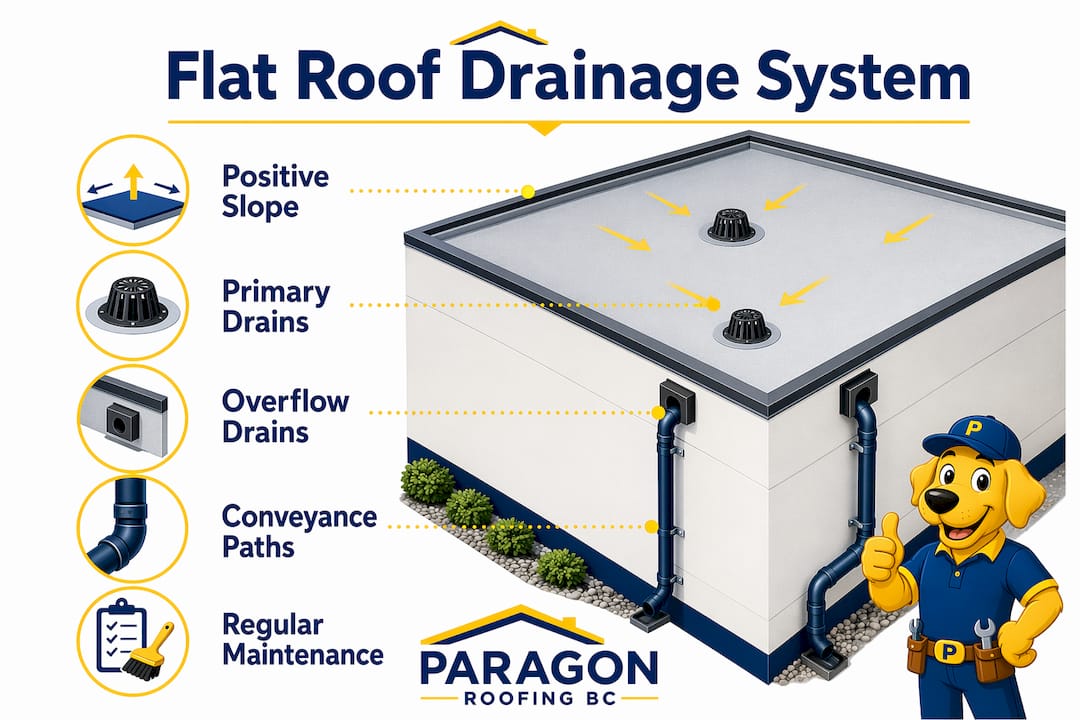
Positive slope
The slope is the foundation of the entire system. Membrane low-slope roofs require a minimum positive slope of approximately 1/4 inch per foot, which equals roughly 2%, directing water toward drainage outlets. Without this slope, even perfectly installed drains cannot do their job. The slope is created either by building it into the structural deck or by using tapered insulation boards laid over a flat deck.
Primary drainage elements
The three main drainage components you will find on most flat roofs are:
- Internal drains: Concealed within the roof assembly and connected to the building’s storm drainage plumbing. Internal drains must be equipped with strainers and clamping rings integrated directly into the roofing membrane. They are the most common choice for larger commercial buildings in Vancouver because they handle high water volumes and are protected from freezing.
- Scuppers: Openings cut through parapet walls or roof edges that allow water to drain off the roof surface. Scuppers are simple, low-maintenance, and very effective when sized correctly. They are common on smaller commercial and multi-family buildings throughout the Lower Mainland.
- Gutters: Perimeter channels that collect water running off the roof edge and direct it to downspouts. Gutters work well on smaller flat roofs and residential applications but require regular cleaning in areas with heavy tree cover.
Secondary overflow drainage
Secondary emergency overflow drains or scuppers act as a backup when primary drains clog or become overwhelmed, preventing structural overload. Building codes require overflow provisions set at a height above the primary drains so they only engage when water levels rise beyond normal. Think of them as the safety valve on a pressure cooker. They should never be the first line of defence, but you absolutely need them.
Pro Tip: Never block or cover overflow scuppers with rooftop equipment or debris. They are your last line of protection against a catastrophic roof collapse during a heavy rain event.
| Component | Primary function | Best suited for |
|---|---|---|
| Internal drain | Connects to storm plumbing below deck | Large commercial roofs, high rainfall areas |
| Scupper | Wall or parapet opening draining to exterior | Mid-size commercial, multi-family buildings |
| Gutter | Perimeter channel directing water to downspouts | Smaller flat roofs, residential applications |
| Overflow drain/scupper | Emergency backup when primary drains fail | All flat roof types, required by code |
Common flat roof drainage solutions and how they work
The right flat roof drainage solution depends on your building type, roof size, and the volume of rainfall your roof must handle. In Metro Vancouver, where annual precipitation regularly exceeds 1,100 millimetres, sizing matters more than most people realise.
Tapered insulation systems
Sloped insulation or tapered decking is used to achieve positive drainage where the structural deck is flat or inadequate. Tapered insulation boards are cut at a factory-specified angle and installed over the flat deck, creating the slope needed to move water toward drains. This is the most common solution on commercial re-roofing projects in Burnaby, Richmond, and Vancouver proper, where the original deck was poured flat. The added benefit is improved thermal performance, since you are adding insulation thickness at the same time.
Internal drain systems with siphonic technology
Standard internal drains work by gravity, filling the pipe and relying on head pressure to move water. Siphonic drainage systems use a different principle: specially designed drain heads create a full-bore flow condition in the pipe, using negative pressure to pull water off the roof at much higher flow rates. Siphonic systems are less common in residential applications but appear on large-footprint commercial and industrial roofs in the Lower Mainland where a single drain must handle a massive catchment area. They require precise engineering and coordination between the roofing and mechanical trades.
Scupper and conductor head systems
Scuppers paired with conductor heads and downspouts are a reliable, visible, and easy-to-maintain option for commercial flat roofs throughout Vancouver. The conductor head sits below the scupper opening and funnels water into the downspout. One practical advantage in BC’s climate: scuppers are less vulnerable to freeze-up than internal drains because they are exposed and drain freely. The trade-off is that they can discharge water onto adjacent surfaces, which requires careful placement.
Here is a quick comparison of the most common flat roof drainage solutions:
| Solution | Maintenance demand | Freeze risk | Typical application |
|---|---|---|---|
| Internal gravity drain | Moderate (strainer cleaning) | Low to moderate | Commercial, multi-family |
| Siphonic drain | Low (self-cleaning at flow) | Low | Large commercial, industrial |
| Scupper with downspout | Low | Very low | Commercial, multi-family |
| Gutter system | High (debris accumulation) | Moderate | Residential, small commercial |
| Tapered insulation slope | None (passive) | None | All types, used with above |
How flat roof drainage works to prevent ponding and damage
The mechanism is straightforward: water lands on the roof surface, the slope directs it toward the nearest drain or scupper, and the drainage component moves it off the roof and into the storm system or away from the building. When any part of that chain breaks down, water pools. And pooled water on a flat roof is a problem that compounds quickly.
The structural load issue is the one that surprises most property owners. A 1,000-square-foot section of roof with just two inches of standing water is carrying over 10,000 extra pounds. That load is not evenly distributed. It concentrates at the lowest point of the roof, which is typically where the deck is already deflecting slightly, creating a bowl effect that makes the ponding worse over time. This is sometimes called “progressive ponding,” and it is one of the leading causes of roof failure and foundation stress in older Lower Mainland buildings.
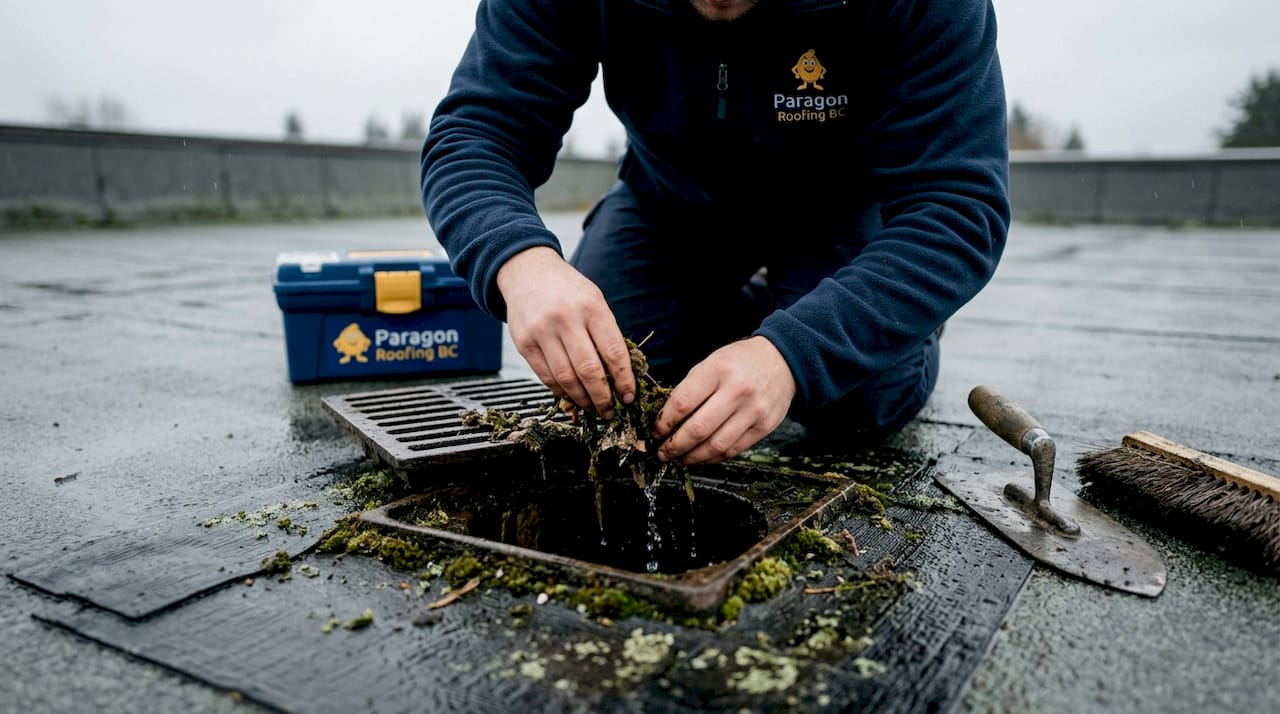
Drainage failures that lead to ponding typically fall into three categories: blocked primary drains, inadequate slope, and failed or missing overflow provisions. Blocked drains are the most common cause in Metro Vancouver because of the volume of leaf litter, pine needles, and biological growth that accumulates on rooftops here. A drain that was clean in September can be completely blocked by November.
“Drains alone without proper slope are insufficient. Effective flat roof drainage requires coordinated design of slope and drainage layout working together.” — IIBEC drainage design guidance
Overflow scuppers are considered the last line of defence and must remain visible and accessible for inspection at all times. When a facility manager covers an overflow scupper with rooftop equipment or allows debris to block it, they are removing the only protection against a catastrophic overload event.
Pro Tip: After any major rain event, walk your roof within 48 hours. If you see standing water, you have a drainage problem that needs attention before the next storm hits.
Maintenance best practices for flat roof drainage in Metro Vancouver
Maintenance is where most flat roof drainage failures actually begin. The system can be perfectly designed and installed, but without regular attention it will fail. Here in the Lower Mainland, the combination of heavy autumn rainfall, organic debris from surrounding trees, and winter freeze-thaw cycles creates a maintenance environment that is more demanding than most of Canada.
Follow this maintenance schedule to keep your flat roof drainage system performing:
- Inspect and clean all drain strainers twice per year. Interior drains should be cleaned at minimum twice annually. In Metro Vancouver, I recommend adding a third inspection in November before the heaviest rains arrive.
- Clear debris from scuppers and gutters every autumn. Leaf litter from maple, oak, and cedar trees is the number one cause of blocked scuppers in Vancouver, Burnaby, and North Vancouver. A blocked scupper in October can mean a flooded roof by December.
- Check overflow paths after every significant storm. Overflow drainage paths must be verified as visibly accessible and set at the correct elevation above primary drains. Walk the roof and confirm nothing has shifted or been blocked.
- Inspect for moss and biological growth each spring. Coastal BC humidity encourages moss growth on rooftop surfaces, which can block drain inlets and retain moisture against the membrane. Treat affected areas with an appropriate biocide and remove growth mechanically.
- Verify positive drainage slope after winter. Freeze-thaw cycles can cause deck movement and membrane displacement. In spring, check that water is still flowing toward drains rather than pooling in new low spots.
- Look for warning signs that require professional attention. Blistering or bubbling membrane, visible cracks near drain flanges, water stains on interior ceilings below the roof, and persistent ponding after 48 hours all indicate problems that go beyond routine maintenance.
Pro Tip: Keep a simple roof log. Record every inspection date, what you found, and what action you took. This documentation protects you if a warranty claim or insurance dispute arises, and it helps a roofing professional quickly identify patterns when they come to assess the roof.
Key takeaways
Effective flat roof drainage requires a coordinated system of positive slope, properly sized primary drains, and code-compliant overflow provisions working together to prevent ponding and structural damage.
| Point | Details |
|---|---|
| Slope is non-negotiable | A minimum 1/4 inch per foot slope directs water to drains and prevents ponding from the start. |
| Overflow provisions save buildings | Secondary drains or scuppers are required by code and prevent catastrophic structural overload when primary drains fail. |
| Ponding causes compounding damage | Water standing over 48 hours adds structural load, degrades membranes, and creates progressive deflection that worsens over time. |
| Maintenance prevents most failures | Cleaning drains twice yearly and inspecting after storms stops the majority of drainage failures before they become costly repairs. |
| BC climate demands more attention | Heavy autumn rainfall, leaf debris, and freeze-thaw cycles make Metro Vancouver roofs more maintenance-intensive than most regions. |
What I’ve learned from years of flat roofs in the Lower Mainland
Hey, it’s Harman here. After inspecting and installing flat roofs across Metro Vancouver, Burnaby, Coquitlam, and the Fraser Valley for years, I can tell you that drainage problems are almost never a surprise. They are the result of decisions made at design, installation, or maintenance that were slightly off, and then ignored until the damage was obvious.
The mistake I see most often is treating drainage as a plumbing problem rather than a roofing problem. When the architect, the plumber, and the roofer are not talking to each other during design, you end up with drain placement and sizing issues that nobody catches until the membrane is already installed. A drain that is two feet from where the slope directs water is essentially useless.
The second thing most people miss is the overflow system. I have been on roofs where the overflow scuppers were buried under rooftop mechanical equipment, or where the building owner had no idea they existed. Those are the roofs that scare me during a heavy November rain. The overflow system is not a nice-to-have. It is the difference between a wet roof and a collapsed one.
My honest advice to any facility manager or property owner in BC: get on your roof twice a year, know where your drains and overflows are, and do not wait for a ceiling stain to tell you something is wrong. Proactive maintenance on a flat roof costs a fraction of what reactive repairs do, and in this climate, the rain will find every weakness you leave unaddressed.
— Harman
Get expert flat roof drainage help in Metro Vancouver
If you are dealing with ponding water, blocked drains, or a flat roof that has never drained properly, Paragonroofingbc has the hands-on experience to diagnose and fix the problem right.
Paragonroofingbc serves property owners and facility managers across the Lower Mainland, from Vancouver and Burnaby to Coquitlam and Delta. Whether you need a full flat roof installation in Coquitlam with a properly engineered drainage system, or a drone roof inspection to identify where your current drainage is failing, the team brings real BC roofing experience to every job. Contact Paragonroofingbc today for a consultation and find out exactly what your roof needs to handle whatever this Lower Mainland winter throws at it.
FAQ
What is flat roof drainage in simple terms?
Flat roof drainage is the system of slope, drains, scuppers, and overflow provisions that moves rainwater off a low-slope roof before it pools and causes damage. It combines a built-in roof pitch with strategically placed drainage components connected to the building’s storm system.
How does flat roof drainage work on a commercial building?
Water flows along the roof surface toward the lowest points, where internal drains or scuppers collect it and direct it into downspouts or the building’s storm plumbing. A minimum slope of 1/4 inch per foot is required to keep water moving rather than pooling.
What causes ponding water on a flat roof?
Ponding water results from blocked drains, insufficient roof slope, or structural deck deflection that creates low spots. Water standing for more than 48 hours after rainfall stops is the standard definition of ponding and signals a drainage problem that needs professional assessment.
How often should flat roof drains be cleaned in Vancouver?
Drain strainers should be cleaned at minimum twice per year, with an additional inspection recommended in late autumn before Metro Vancouver’s heaviest rainfall season. Scuppers and gutters in tree-lined areas may need clearing more frequently due to leaf and debris accumulation.
What is the difference between a primary drain and an overflow drain?
A primary drain handles normal rainwater flow and connects directly to the storm drainage system. An overflow drain or scupper sits at a higher elevation and only activates when the primary drain is overwhelmed or blocked, acting as a code-required safety backup to prevent structural overload.
Recommended
Our Roofing Blog


Have more questions about roofing?
Check out our FAQs or give us a call today to speak to an expert roofer in Vancouver Lower Mainland, BC. We're here to help our neighbours make educated decisions about their roof. For our team, we value helping clients save money while making their roofs last.