
Surrey roof flashing failure causes: what homeowners must know
Surrey roof flashing failure causes: what homeowners must know
TL;DR:
- Roof flashing failure occurs when metal or sealant components at roof transitions break down, allowing water entry. Common causes include deteriorated sealant, cracked pipe boots, and missing kick-out flashing, which can lead to water damage and structural rot. Regular inspections, proper installation, and routine maintenance can prevent costly repairs caused by flashing failure in Surrey’s climate.
Roof flashing failure is defined as the breakdown of the metal or sealant components installed at roof transitions to divert water away from vulnerable joints. Surrey roof flashing failure causes range from deteriorated sealant at counter-flashing reglets to missing kick-out flashing at roof-to-wall junctions, and every one of them creates a pathway for water to enter your home. Flashing degrades faster than shingles because it bears the full force of concentrated water flow, wind, and coastal moisture. Surrey’s wet winters and freeze-thaw cycles make this problem worse than in drier climates. Catching these failures early is the difference between a minor repair and a major structural bill.
What are the main causes of roof flashing failure in Surrey?
The single most common cause of chimney flashing leaks is failed sealant at counter-flashing reglets, which typically deteriorates within 8–12 years of installation. That timeline matters because most Surrey homeowners assume flashing lasts as long as their shingles. It does not.
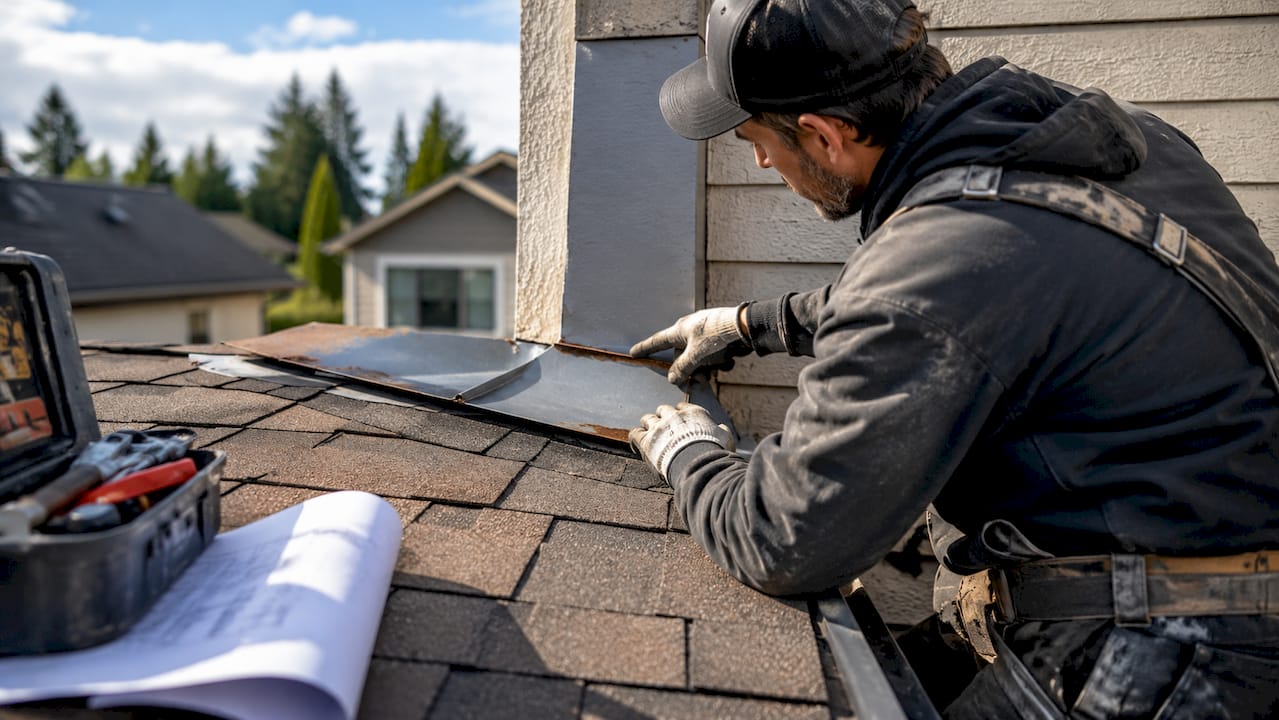
The second most frequent failure point is the rubber pipe boot. These cone-shaped seals wrap around plumbing vents that poke through your roof. UV exposure and Surrey’s freeze-thaw cycles crack the rubber, and pipe boots fail at 10–15 years on average. Once cracked, every rainstorm pushes water straight down the pipe penetration and into your ceiling.
A third cause that gets overlooked far too often is missing or improperly installed kick-out flashing. This small piece of metal sits where a sloped roof meets a vertical wall. Without it, water runs behind the siding and soaks into the wall framing. The rot that follows can take years to become visible, by which point the repair cost has multiplied.
Here are the primary Surrey-specific failure causes to watch for:
- Reglet sealant failure: Counter-flashing embedded in mortar or reglets relies on sealant that degrades in 8–12 years under coastal conditions.
- Cracked rubber pipe boots: UV and freeze-thaw cycles break down rubber faster in Surrey than in drier inland climates.
- Missing kick-out flashing: A latent installation defect that causes hidden structural rot at roof-to-wall transitions.
- Sealant used as the primary barrier: Caulk-only repairs fail within 2–5 years because sealant is not a substitute for properly lapped metal flashing.
- Wind-driven rain infiltration: Surrey’s coastal storms push water upward under lifted or improperly bedded flashing edges.
- Debris accumulation at valleys: Leaves and granules dam water at valley flashing, holding moisture against the metal and accelerating corrosion.
Pro Tip: If your home is 10 years old or older and has never had a flashing inspection, schedule one now. The sealant at your chimney reglets is almost certainly past its reliable service life.
How does poor drainage accelerate flashing failure on Surrey flat roofs?
Chronic ponding is the leading driver of premature flat roof failure in Surrey. When drainage outlets are blocked or the roof lacks adequate fall, water pools and sits. That standing water does not just stress the membrane. It works its way into every flashing joint it contacts, softening adhesives and forcing sealant edges apart.
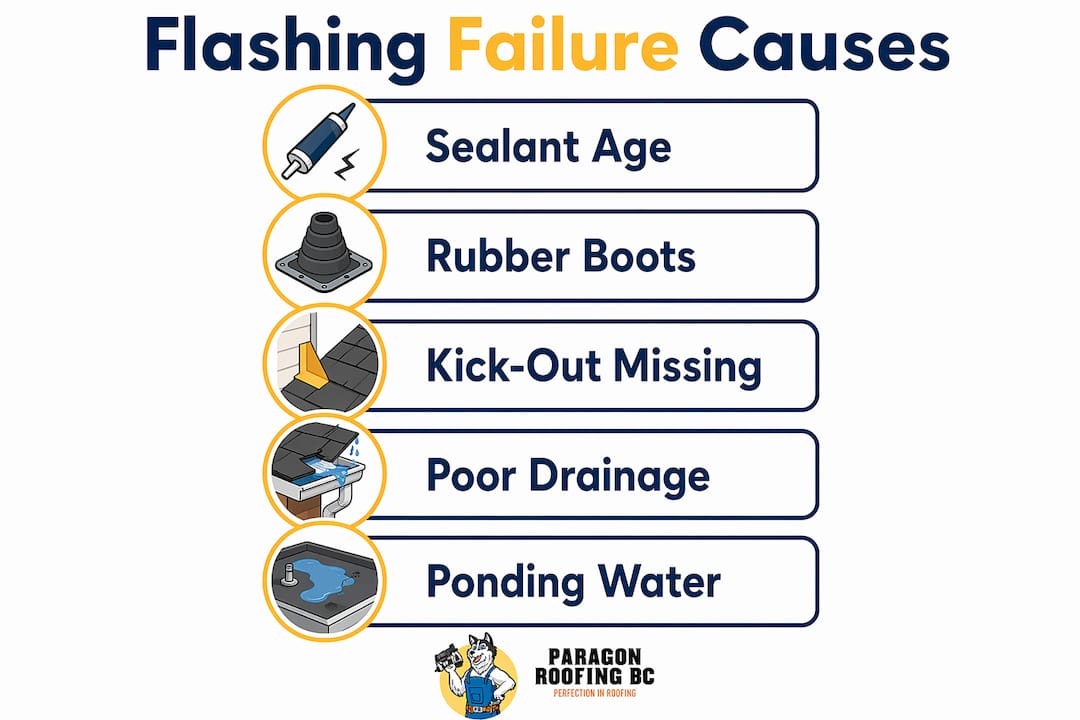
Flat roofs require drain and gutter clearing twice yearly to prevent this cycle. The two critical windows are late autumn, after leaves have fallen, and early spring, after winter debris has settled. Missing either cleaning means you are running your roof under stress for months at a time.
Surrey flat roof drainage failure causes follow a predictable sequence:
- Outlet blockage: Leaves, granules, and moss clog drains or downspout inlets.
- Ponding develops: Water pools across the membrane surface, often invisibly from ground level.
- Flashing edges saturate: Standing water contacts base flashing at parapet walls and penetrations, softening the seal.
- Membrane stress increases: The added weight of ponded water stresses the roof deck and any existing flashing repairs.
- Failure accelerates: What started as a slow seep becomes an active leak during the next heavy rain.
| Warning sign | What it means |
|---|---|
| Water marks on parapet walls | Ponding has reached flashing height and is seeping behind the base flashing |
| Granule buildup at drains | Shingle granules are clogging outlets and slowing drainage |
| Soft or spongy deck areas | Prolonged moisture has saturated the roof deck beneath the membrane |
| Rust stains on metal flashing | Standing water is corroding flashing faster than normal weathering would |
Pro Tip: After any major Surrey rainstorm, walk the perimeter of your flat roof or check from an upper window. If you see standing water 48 hours after rain stops, your drainage is failing and your flashing is under stress.
What visible signs help you identify flashing failure early?
Early detection is the most cost-effective tool you have. Visible flashing failure signs include rust streaks running down exterior walls, lifted or buckled metal edges, cracked pipe boots, and missing kick-out flashing sections. Each one is a red flag that water is already finding a path in.
Inside your home, the clues are just as clear. Water stains on ceilings near chimneys or in corners below roof valleys point directly to flashing problems. Attic moisture, mould on rafters, or damp insulation near a roof penetration all confirm that water has been entering for some time. Check these areas after every significant rainstorm.
The tricky part is that water travels horizontally inside roof assemblies, meaning the stain on your ceiling may be a metre or more away from the actual failure point. This is why visual inspection alone has limits. Thermal imaging cameras detect temperature differences caused by hidden moisture, pinpointing the real entry point without tearing open your ceiling. Paragonroofingbc uses thermal imaging as part of its leak detection process for exactly this reason.
Watch for these exterior and interior indicators:
- Rust streaks on siding or brick below flashing lines
- Lifted or separated metal at chimney bases, valleys, or wall junctions
- Cracked or collapsed rubber around plumbing vents
- Missing kick-out flashing where a roof slope meets a side wall
- Ceiling stains near chimneys, skylights, or roof valleys
- Attic mould or damp insulation near any roof penetration
- Paint bubbling or peeling on interior walls below roof-to-wall transitions
For a broader look at BC roof leak causes, the pattern is consistent: flashing is almost always involved.
How can Surrey property owners prevent flashing failure?
Prevention costs a fraction of what repairs do once water has entered the wall or deck. The foundation of any prevention plan is proper installation. Metal flashing must serve as the primary waterproof layer, with sealant used only as a secondary seal at laps and edges. Relying on caulk alone is a shortcut that fails within a few years.
Routine maintenance is equally non-negotiable. Clearing gutters and drainage outlets twice yearly removes the debris that causes ponding and backs water up against flashing. Surrey’s heavy leaf fall in october and november makes the late-autumn clean particularly important.
Material choices matter too. UV-resistant flashing materials and timely pipe boot replacement at the 10–15 year mark keep your roof sealed through Surrey’s climate swings. Galvanised steel and copper both outperform aluminium in coastal conditions. When you are replacing a roof, insist on proper step flashing at every wall junction rather than a continuous piece of bent metal.
Key prevention steps for Surrey homeowners:
- Schedule a flashing inspection every 8–12 years , especially at chimney reglets and pipe boots.
- Clear gutters and roof drains in late autumn and early spring without fail.
- Install kick-out flashing at every roof-to-wall transition during any re-roofing work.
- Replace rubber pipe boots before they crack, not after the leak appears.
- Use UV-resistant metal flashing rather than relying on sealant as the primary seal.
- Remove debris dams from valleys and around penetrations after major storms.
Pro Tip: When getting a new roof, ask your contractor specifically about kick-out flashing at every wall junction. Many crews skip it because it adds time. That omission will cost you far more in siding and framing repairs within a decade.
For a detailed walkthrough of repair steps, the flashing repair guide for BC homeowners covers the most common fixes in plain language.
Key takeaways
Roof flashing failure in Surrey is caused primarily by deteriorated sealants, cracked pipe boots, and missing kick-out flashing, all of which are preventable with scheduled inspections and proper installation.
| Point | Details |
|---|---|
| Reglet sealant lifespan | Counter-flashing sealant fails within 8–12 years; schedule inspections before that window closes. |
| Pipe boot replacement | Rubber boots crack at 10–15 years; replace them proactively to avoid active leaks. |
| Kick-out flashing gaps | Missing kick-out flashing causes hidden wall rot that can take years to surface. |
| Drainage maintenance | Clear gutters and drains twice yearly to prevent ponding that stresses flat roof flashing. |
| Thermal imaging value | Hidden moisture travels horizontally; thermal imaging finds the real failure point, not just the visible stain. |
What I have learned from inspecting Surrey roofs for years
Hey, it’s Harman here. After inspecting roofs across Surrey for years, the pattern I see most often is this: homeowners assume their flashing is fine because their shingles look fine. Those are two completely different systems with different lifespans, and flashing almost always goes first.
The misconception that bothers me most is the caulking fix. I have seen homeowners and even some contractors slap a bead of caulk over a lifted flashing edge and call it done. That repair has a lifespan measured in months, not years. Surrey’s rain and freeze-thaw cycles will open that gap again before the next winter is over. Metal lapped correctly over metal is the only fix that lasts.
What I have also noticed is that Surrey’s coastal moisture is genuinely harder on flashing than people expect. The combination of wet winters, occasional freezing, and UV in the summer creates a cycle that chews through rubber and sealant faster than you would see in a drier climate like the Interior. That means the standard inspection timelines you read about online are often too generous for our local conditions.
My honest advice: do not wait for a stain on your ceiling. By the time water shows up inside, it has usually been travelling through your roof assembly for months. A proactive inspection at the 8-year mark, especially around chimneys and pipe boots, will catch failures before they become expensive. If your home is near the 10-year mark and has never had flashing looked at, that is the single highest-value thing you can do for your roof this year.
— Harman
Paragonroofingbc’s flashing inspection services for Surrey homeowners
Paragonroofingbc works with Surrey homeowners and property managers who want to get ahead of flashing problems before they turn into water damage claims. The team uses thermal imaging to find hidden moisture at flashing connections, which means you get an accurate diagnosis rather than a guess based on ceiling stains.

Whether you have a sloped residential roof with aging chimney flashing or a flat commercial roof with drainage concerns, Paragonroofingbc’s Surrey residential roofing team can assess your flashing condition and recommend repairs that are built to last through Surrey’s climate. Proactive maintenance now is always less expensive than structural repairs later. Reach out to Paragonroofingbc to book a flashing inspection and get a clear picture of where your roof stands.
FAQ
What is the most common cause of roof flashing leaks in Surrey?
Failed sealant at counter-flashing reglets is the leading cause, typically deteriorating within 8–12 years. Cracked rubber pipe boots are the second most common failure point, usually at 10–15 years.
How do I know if my kick-out flashing is missing?
Look where your sloped roof meets a vertical side wall. If there is no small angled metal piece directing water away from the wall, kick-out flashing is absent. Water stains or paint peeling on the siding below that junction confirm the problem.
Can I repair flashing with caulk alone?
No. Sealant used as the primary waterproof barrier fails within 2–5 years under UV and temperature cycling. Metal flashing properly lapped and bedded must provide the main seal, with sealant only at secondary joints.
How often should Surrey homeowners inspect their roof flashing?
A professional flashing inspection every 8–12 years is the minimum. Surrey’s coastal moisture and freeze-thaw cycles make the lower end of that range more appropriate for most homes.
Why does my ceiling stain appear far from the chimney?
Water travels horizontally inside roof and wall assemblies before it drips through. The visible stain can be a metre or more from the actual flashing failure. Thermal imaging is the most reliable way to locate the true entry point.
Recommended
Our Roofing Blog


Have more questions about roofing?
Check out our FAQs or give us a call today to speak to an expert roofer in Vancouver Lower Mainland, BC. We're here to help our neighbours make educated decisions about their roof. For our team, we value helping clients save money while making their roofs last.